Showing posts with label customer information management. Show all posts

Friday, January 31, 2014

Top Three Reasons why B2B Marketers Struggle with Data Analytics

Why does B2B Marketing Struggle with Data Analytics?

A  report from the CEB (Corporate Executive Board) Marketing Leadership Council on the Digital Evolution in B2B Marketing echoes our own research and indicates that B2B marketers are struggling with implementing data analytics solutions in their firms.  Not Surprisingly, the issue is often one of data quality. This illustration shows that poor data quality and analytics capability leads to a lack of meaningful insight, which in turn can lead to a lack of funding for data quality and analytics efforts.

CEB Marketing Leadership Council Report on the Digital Evolution in the B2B Marketplace, 2012

Lack of Results Leads to Lack of Funding

The result of poor data quality is a vicious circle where marketers cannot get the proper funding for their efforts.  Our research results reinforce the results shown in this graphic but also link data quality to customer performance.  In our recent paper in the Journal of Interactive Marketing volume 27, Issue 1, February 2013, co-authors James Peltier, Don Lehman and I present a model with empirical evidence from the banking industry, both B2B and B2C applications.  The article is called Organizational Learning and CRM Success: A Model for Linking Organizational Practices, Customer Data Quality, and Performance.

In the article we measure customer data quality in the organizational context.  We not only show the linkages from customer data quality to ultimate firm performance as measured by growth, we explore this result in an organizational context.  Without the cultural that values analytics and data, data quality cannot be obtained. Culture means not only top management support but parts of the organization working together.

Top Three Reasons Why B2B Marketers Struggle at Analytics

Therefore, the top three reasons I see why B2B organizations cannot achieve analytics success are as follows:

1) Lack of a cooperative culture that supports data quality.
2) Lack of support by upper management for data quality efforts.
3) The resulting poor quality data that leads to poor decisions.

I will follow up this blog post with more information about the link between data quality and customer performance as reported in our research.  I thought the CEB report hit the nail on the head in terms of illustrating the grim consequences of a lack of customer data quality and the conclusions dovetailed nicely with our own research results.   In the meantime, please feel free to contact me with any questions about this material or our article.

By Debra Zahay-Blatz.
You can find Debra on  and Twitter as well as LinkedIn.

Saturday, November 16, 2013

Secrets of Innovation and Data Management from Kayak

Terry Jones, former Ceo of Travelocity, spoke a the recent DMA conference at McCormick Place in Chicago.  Mr. Jones not only founded Travelocity.com and acted as CIO of Sabre, Inc, but also functions as Chairman of Kayak.com.  Terry has a proven track record of leading companies whose innovations have change the travel industry and has used data-driven digital marketing to spur company growth.

We Need Not "Big Data' But "Big Wisdom"

One of Jones'  themes was data-driven digital marketing and its role in innovation.  Terry said, and I agree, that as marketers we don't need 'big data' as much as 'big wisdom'.  Only about one percent of data is acted upon in corporations.  We need people with vision to know how to harness the data the companies already have. Jones said we need to get rid of the "Bozone" Layer that stifles innovation by using smaller, more effective teams and other techniques to encourage new ideas.
bozone layer, innovation
Terry Jones from Kayak on How NOT to Stifle Innovation
Jones spoke of the changes in marketing and the challenges these changes post to marketers.  He said it took 40,000 years for men to invent the fishing net, another 23,000 to invent the fish hook and less than four years for the majority of American households to have a tablet computer.   When customers trust reviews from people they have never met on the internet instead of the brand, the customer is extremely powerful, "wired and dangerous."  And this customer expects your site to be the best, 24 by 7.

We Must Inspire Employees to Innovate

To reach the current customer, who is Internet empowered, tech savvy, time starved and information, rich requires managing and inspiriting innovation in the corporation.  This approach is consistent with research my co-authors and I have conducted on how to organize effectively to manage data in the corporation.  This research indicates that top management support is critical in creating quality, actionable data.  We have also conducted research about how data is used throughout the corporation in the innovation process.

Using his own firm as an example of innovation, Jones said that Kayak relies heavily on data analysis in designing its web site.  He said 20% of everything you see at the Kayak web site is a a test and that he encourages testing and does not punish failure.   He encouraged companies to "Kill Projects, Not People" and hire people who don’t 'fit' the mold.  He also said most innovation comes from the bottom, from those who are talking to customers.

Those Who Survive, Adapt

Jones quoted Darwin saying those who survive are not the biggest and stronger but those who most respond and adapt to change.  Today, we can use the internet and data analysis to build virtual firms that react quickly.  Jones said Kayak, a comparison engine for travel sites, went public for 1.8 billion dollars using open source code, search engine technology and only 220 people.  Certainly this model poses a challenge to us all to innovate and create by managing our people and data well and using 'wisdom' and not just 'data.'

By Debra Zahay-Blatz.
You can find Debra on  and Twitter as well as LinkedIn.

Monday, August 19, 2013

Middle Management Secrets for Big Data

Middle Management Lost in the Big Data Shuffle

If data quality gets lost in the shuffle in Big Data implementation, so also does the role of Middle Management.  Despite the promise of data management and big data, many of the firms investing in customer information technology have  witnessed limited financial success from their data-driven efforts designed to get close to customers.


big data, middle management


As a consequence, many adopters became disillusioned and learned for themselves that customer-centricity is difficult to accomplish, requires a high level of coordination between IT and marketing, and involves a cultural shift with regard to how customer data are integrated and shared within and between functional areas (Zahay and Peltier, 2007). 


Data Quality Improves When Middle Management Feels Involved

The interpersonal and organizational factors of big data implementation, which  my co-authors and I have been studying since 2007, has only recently come to the forefront as critical to the success of Big Data projects.  In fact, our research shows that companies where middle management believes it is involved in customer data management and feels supported, data quality improves and so does firm performance. So it is critical to involve middle management in customer information processes.  

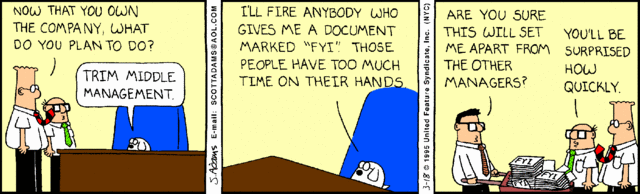
Middle managers, as our Dilbert, cartoon illustrates, often take a back seat or are assigned limited importance in organization. However, these managers play a key role in strategy execution, particularly in cross-functional efforts such as CRM and Big Data.  Prior work from the Gartner Group suggests that among the building blocks of successful CRM implementation, which is a customer data-dependent application are Organizational Collaboration, and Organizational Processes.    


How to Involve Middle Managers in Big Data

What does it mean to involve Middle Management and improve organizational collaboration?  These results are based on 128 responses from managers in the financial services industry.  In our survey we asked middle managers three key questions to which they responded on a scale of 1-5 with 5 being strongly agree and 1 being strongly disagree.  The questions were as follows:

  1. We feel comfortable calling our upper management when the need arises
  2. Our marketing management is responsive ot our customer information ides
  3. Marketing managers can easily schedule meetings with upper management

Marketing management support was strongly correlated with customer data quality, which in previous research we have demonstrated to be related to ultimate firm performance.  In a regression analysis, marketing manager support was also significant in predicting customer data quality.  These results are consistent with other research we have conducted (Zahay and Peltier 2008) and show the importance of involving middle management in the process.


Bottom-Up Strategy is the Key

It appears that in order to ensure data quality, the firm’s middle management and upper management must have an open and communicative relationship.  Consistent with findings from practice, the most successful organizational relationships in these companies had a clear role for middle management in translating the language of quality customer information management to upper management.  These results are also consistent with several schools of thought in strategy, which support the idea that strategy comes from the bottom up, or at least from middle management back to top management (Bower 1986).  

By Debra Zahay-Blatz.
You can find Debra on  and Twitter as well as LinkedIn.

Friday, June 7, 2013

How I Became a Data-Driven Digital Marketing Specialist


Who I Am


This is my first blog post for my new Data-Driven Digital Marketing blog and I wanted to introduce myself.  My name is Debra Zahay-Blatz (publishing as Debra Zahay) and I am a Professor of Digital Marketing, the co-author of the leading textbook in Internet Marketing, Internet Marketing, Integrating Online and Offline Strategies and the Editor of The Journal of Research in Interactive Marketing. I also have had my own Data-Driven Digital Marketing consulting firm since 1993, Zahay, Inc.

What I Do


With my co-authors, I have published widely in the area of customer information management. I currently writing a book that I hope will help companies understand how to organize and manage customer information.  You can read more about me on my company website or come here me speak on this subject at eMetrics next week on "Organizing for Customer Data Management."

Although I have a strong statistical and analytics background, my primary research interests are the managerial side.  I research how customer information can be managed for competitive advantage and recently I have been exploring the role of data quality in this process.  The above graphic illustrates my personal journey in customer data management. I can saw I came by this professional  pursuit honestly and, like many of you, through direct and database marketing. I teach Internet Marketing, including search and social media, as well as database marketing, analytics and data mining.

How I Began


The journey really began with receiving my Master's in Management from the Kellogg school at Northwestern University. (I should say that I went to the greatest marketing school in the world and studied Quant Methods and Finance, figuring if I knew something about statistics, numbers and the computer I would always get a job; who knew how marketing would evolve?).

This background eventually led me to a division of Dun & Bradstreet where we sold data and software to the investment community, banks, brokerage firms, investment advisers.  There I learned about software development and implementation, data cleansing and management.  We used direct marketing techniques and customer databases because we marketed B2B and it was the most cost-effective approach and produced the best results.  I was promoted from support, to sales to marketing management and eventually back to the field for sales management.  Along the way we always used customer information to inform our sales and marketing plans. (I always say if I had a nickel for every database I have created I would have about $1.50 right now.  Data drove many of my decisions).

What I learned about customer databases I employed in my next company as Sr. Manager of Vertical Marketing programs in the Central Division for MCI Telecommunications (now Verizon).  I got the job based on the success we had in the Teleconferencing division with targeted vertical campaigns.  For the division, we developed and implemented a targeted, integrated marketing communications campaign for our insurance vertical using multiple channels and integrating sales force communication.  Critical to our success was the development of a customer and prospect database, which involved integrating five different databases across the company.  It was a classic case of data silos and no consistent way to map customer data through a single identifier.

Our efforts paid off and we made millions on a $15,000 out of pocket investment and our staff time.  I presented the results of the campaign at my first global marketing conference, ESOMAR in Europe, and started thinking from that point on that I wanted to know more about customer information management and the link to profitability.

The Big Question


So for several years after that experience I would go to practitioner conferences and ask people, "What is the link between managing company information well and performance and do you have any information on that link?"  Long story short, I never found anyone who had answered this question to my satisfaction.  I was teaching at DePaul University by then and the department chair encouraged me to get a Ph.D. and the answers to my questions.

The Ongoing Answers


So I enrolled in the Ph.D. Program in Marketing at the University of Illinois at Urbana-Champaign and received my degree in 2000.  My thesis was on the role of strategy (positioning, customization and personalization), customer information management and ultimate firm performance. My econsultancy guest blog "Why Doesn't Everyone do Big Data?" summarizes some of this research.   I got the answers to my questions and have been sharing them with the academic and professional world.  I look forward to sharing my ideas on my new blog, listening to and interacting with my readers.  I have found specializing in Data-Driven Digital Marketing to be a wonderful career, rewarding intellectually and professionally and I look forward to giving back to our great community through this blog.

By Debra Zahay-Blatz.
You can find Debra on  and Twitter as well as LinkedIn.