Showing posts with label digital marketing. Show all posts

Monday, March 3, 2014

How Your Brand Helps Your "Rank"

Building Your Brand Digitally 

One of the most important aspects of data-driven digital marketing is branding.  Branding can be simply put as a 'promise' or how the company is perceived by its customers.  Google wishes to be the world's information conduit, Facebook its communications conduit and Amazon.com its commerce conduit.  Each of these firms has a clear idea of what and who it is and relates that information to the outside world.

Branding is important in digital marketing because brand equity is the value of our firm to that outside world. Coming up with our brand image is the first step, after which we develop our brand story and generate content on various channels. These activities create awareness and recognition for our brand and finally, brand equity.  Brand equity has both a financial component in terms of our brand's value and a component of competitive advantage in terms of how our brand is positioned.

For most firms, the challenge becomes integrating the brand promise not only with the firm's offline communications but online as well.  In fact, it is my personal belief that branding is more important now that we are so reliant on the internet to achieve our marketing objectives.  Branding as a concept can be elusive to those who seek to quantify their digital marketing efforts but we can see the results on SERPs (Search Engine Results Pages). There are many ways to reinforce our brands online:  Search, social media, mobile communications, email, etc.  Each of these forms of communication must reinforce who we are and how we wish people to perceive our brand.

branding, search
Branding Leads to Search Success


Search Rankings Reflect Brand Strength

However, I have often said that search is strategy.  Understanding who we are and how people search for us is the most critical aspect of our digital marketing management process.  Search engines like Google give acknowledgement to branding efforts.  You may have noticed that when you type in a product name large retailers like Amazon and Walmart come up first, with specialty firms showing up sometimes not until the second page of the search results.

The reason for this result is that Google's algorithms give special attention to strong brands because they are trying to 'cut through the clutter' on the internet and provide searchers something of value.  Small companies need to work even harder than large companies to build their brand.  Starting with a clear story, telling that story through related content through online channels will increase the chances of having a strong brand.  A strong brand will in turn rank highly in search results.

By Debra Zahay-Blatz.
You can find Debra on  and Twitter as well as LinkedIn.

Monday, August 19, 2013

Middle Management Secrets for Big Data

Middle Management Lost in the Big Data Shuffle

If data quality gets lost in the shuffle in Big Data implementation, so also does the role of Middle Management.  Despite the promise of data management and big data, many of the firms investing in customer information technology have  witnessed limited financial success from their data-driven efforts designed to get close to customers.


big data, middle management


As a consequence, many adopters became disillusioned and learned for themselves that customer-centricity is difficult to accomplish, requires a high level of coordination between IT and marketing, and involves a cultural shift with regard to how customer data are integrated and shared within and between functional areas (Zahay and Peltier, 2007). 


Data Quality Improves When Middle Management Feels Involved

The interpersonal and organizational factors of big data implementation, which  my co-authors and I have been studying since 2007, has only recently come to the forefront as critical to the success of Big Data projects.  In fact, our research shows that companies where middle management believes it is involved in customer data management and feels supported, data quality improves and so does firm performance. So it is critical to involve middle management in customer information processes.  

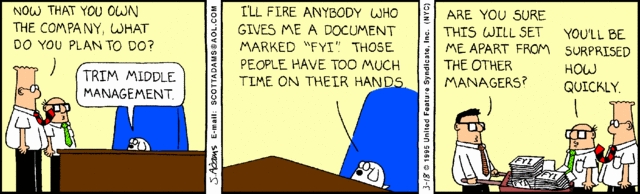
Middle managers, as our Dilbert, cartoon illustrates, often take a back seat or are assigned limited importance in organization. However, these managers play a key role in strategy execution, particularly in cross-functional efforts such as CRM and Big Data.  Prior work from the Gartner Group suggests that among the building blocks of successful CRM implementation, which is a customer data-dependent application are Organizational Collaboration, and Organizational Processes.    


How to Involve Middle Managers in Big Data

What does it mean to involve Middle Management and improve organizational collaboration?  These results are based on 128 responses from managers in the financial services industry.  In our survey we asked middle managers three key questions to which they responded on a scale of 1-5 with 5 being strongly agree and 1 being strongly disagree.  The questions were as follows:

  1. We feel comfortable calling our upper management when the need arises
  2. Our marketing management is responsive ot our customer information ides
  3. Marketing managers can easily schedule meetings with upper management

Marketing management support was strongly correlated with customer data quality, which in previous research we have demonstrated to be related to ultimate firm performance.  In a regression analysis, marketing manager support was also significant in predicting customer data quality.  These results are consistent with other research we have conducted (Zahay and Peltier 2008) and show the importance of involving middle management in the process.


Bottom-Up Strategy is the Key

It appears that in order to ensure data quality, the firm’s middle management and upper management must have an open and communicative relationship.  Consistent with findings from practice, the most successful organizational relationships in these companies had a clear role for middle management in translating the language of quality customer information management to upper management.  These results are also consistent with several schools of thought in strategy, which support the idea that strategy comes from the bottom up, or at least from middle management back to top management (Bower 1986).  

By Debra Zahay-Blatz.
You can find Debra on  and Twitter as well as LinkedIn.

Friday, June 7, 2013

How I Became a Data-Driven Digital Marketing Specialist


Who I Am


This is my first blog post for my new Data-Driven Digital Marketing blog and I wanted to introduce myself.  My name is Debra Zahay-Blatz (publishing as Debra Zahay) and I am a Professor of Digital Marketing, the co-author of the leading textbook in Internet Marketing, Internet Marketing, Integrating Online and Offline Strategies and the Editor of The Journal of Research in Interactive Marketing. I also have had my own Data-Driven Digital Marketing consulting firm since 1993, Zahay, Inc.

What I Do


With my co-authors, I have published widely in the area of customer information management. I currently writing a book that I hope will help companies understand how to organize and manage customer information.  You can read more about me on my company website or come here me speak on this subject at eMetrics next week on "Organizing for Customer Data Management."

Although I have a strong statistical and analytics background, my primary research interests are the managerial side.  I research how customer information can be managed for competitive advantage and recently I have been exploring the role of data quality in this process.  The above graphic illustrates my personal journey in customer data management. I can saw I came by this professional  pursuit honestly and, like many of you, through direct and database marketing. I teach Internet Marketing, including search and social media, as well as database marketing, analytics and data mining.

How I Began


The journey really began with receiving my Master's in Management from the Kellogg school at Northwestern University. (I should say that I went to the greatest marketing school in the world and studied Quant Methods and Finance, figuring if I knew something about statistics, numbers and the computer I would always get a job; who knew how marketing would evolve?).

This background eventually led me to a division of Dun & Bradstreet where we sold data and software to the investment community, banks, brokerage firms, investment advisers.  There I learned about software development and implementation, data cleansing and management.  We used direct marketing techniques and customer databases because we marketed B2B and it was the most cost-effective approach and produced the best results.  I was promoted from support, to sales to marketing management and eventually back to the field for sales management.  Along the way we always used customer information to inform our sales and marketing plans. (I always say if I had a nickel for every database I have created I would have about $1.50 right now.  Data drove many of my decisions).

What I learned about customer databases I employed in my next company as Sr. Manager of Vertical Marketing programs in the Central Division for MCI Telecommunications (now Verizon).  I got the job based on the success we had in the Teleconferencing division with targeted vertical campaigns.  For the division, we developed and implemented a targeted, integrated marketing communications campaign for our insurance vertical using multiple channels and integrating sales force communication.  Critical to our success was the development of a customer and prospect database, which involved integrating five different databases across the company.  It was a classic case of data silos and no consistent way to map customer data through a single identifier.

Our efforts paid off and we made millions on a $15,000 out of pocket investment and our staff time.  I presented the results of the campaign at my first global marketing conference, ESOMAR in Europe, and started thinking from that point on that I wanted to know more about customer information management and the link to profitability.

The Big Question


So for several years after that experience I would go to practitioner conferences and ask people, "What is the link between managing company information well and performance and do you have any information on that link?"  Long story short, I never found anyone who had answered this question to my satisfaction.  I was teaching at DePaul University by then and the department chair encouraged me to get a Ph.D. and the answers to my questions.

The Ongoing Answers


So I enrolled in the Ph.D. Program in Marketing at the University of Illinois at Urbana-Champaign and received my degree in 2000.  My thesis was on the role of strategy (positioning, customization and personalization), customer information management and ultimate firm performance. My econsultancy guest blog "Why Doesn't Everyone do Big Data?" summarizes some of this research.   I got the answers to my questions and have been sharing them with the academic and professional world.  I look forward to sharing my ideas on my new blog, listening to and interacting with my readers.  I have found specializing in Data-Driven Digital Marketing to be a wonderful career, rewarding intellectually and professionally and I look forward to giving back to our great community through this blog.

By Debra Zahay-Blatz.
You can find Debra on  and Twitter as well as LinkedIn.